
Drylining and Plasterboarding
Drylining and Plasterboarding for Dorset Builders.
Boards plumb, joints staggered, surfaces ready for the next trade. Dot and dab, metal stud partitions, ceiling boards and taped joints for extensions, loft conversions and full renovations across Bournemouth, Poole and the wider Dorset area.
Get my itemised quoteThe fastest route to a finished interior
Drylining is the modern alternative to wet plastering on solid walls, and for new build and extension work, plasterboarding is the standard approach. Rather than applying thick coats of base plaster, we fix plasterboard to the wall (either mechanically with metal stud, or with adhesive on dot and dab), then skim the boards to a flat finish. The result is the same paint-ready surface, but the drylining route is faster, cleaner, and lets the next trade in days sooner. Wondering whether drylining or wet plaster is right for your walls? Read our guide on drylining vs wet plaster.
We handle every drylining job from boarding a single stud partition to fully plasterboarding an entire extension. That includes cutting reveals and arches, fitting ceiling boards, fixing insulated thermal board to cold external walls, and taping and jointing where the boards are going direct to paint. Most of our drylining work then runs straight into a finish skim through our domestic plastering and skimming service, so one team owns the wall from blockwork to paint-ready surface.
Pearl Plastering covers drylining and plasterboarding across Bournemouth, Poole, Christchurch and the wider Dorset area. Loft conversions in Winton, garage conversions in Parkstone, full extension boarding in Ferndown and new-build developments across the New Forest. For builders running multi-plot sites, we offer dedicated builder packages with per-plot pricing.
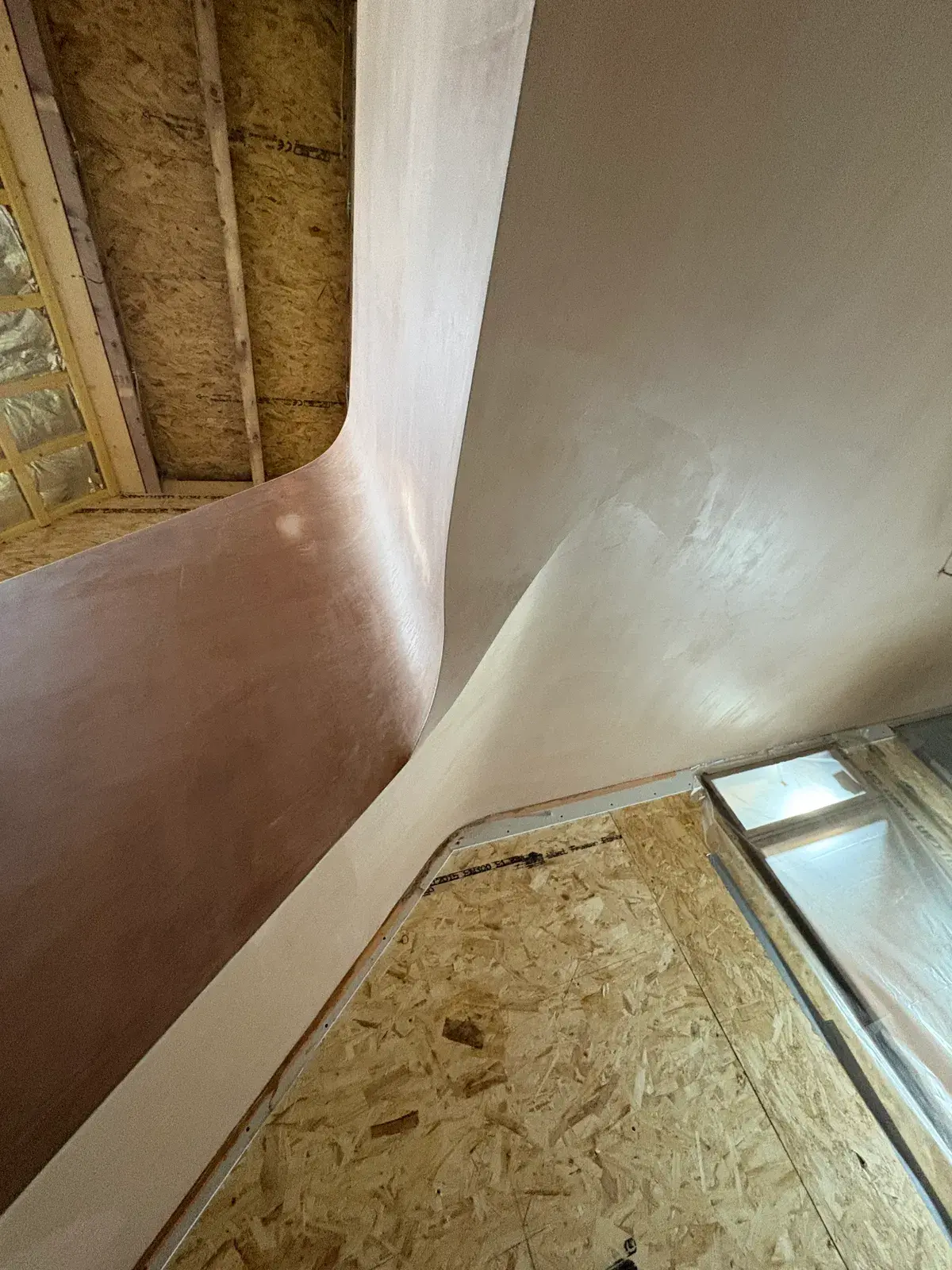
Dot and dab or metal stud? The decision in one minute.
Most drylining jobs come down to this choice. The wall behind decides for you.
Dot and dab plasterboarding
Plasterboard bonded directly to solid masonry with adhesive dabs. Adds about 25mm to the wall. The right call when the wall behind is sound, reasonably plumb, and you want the room to keep its dimensions. Most refurbs in Bournemouth, Poole and Christchurch terraced housing end up here.
Where it stops being the right call: damp masonry, period properties that need to breathe, or walls so far out of plumb the dabs would be 40mm deep. In those cases we recommend metal stud or a different fix entirely. Full detail on the method on our dot and dab plastering page.
Metal stud plasterboarding
A galvanised steel frame fixed floor-to-ceiling, then plasterboarded both faces. Adds 70 to 100mm per face. The right call when you need a new partition wall, a service void for first fix, or you want to lose insulated thickness behind the boards without losing room width to thick render.
Where it’s the only option: brand-new partition walls, loft conversions where the existing studs need timber-or-steel boxing, anywhere the plumber and electrician need a clear void to first-fix into. Drylined right, the joint between two adjacent stud walls is invisible once skimmed.
The board on your wall matters more than people think.
Standard 12.5mm plasterboard handles a dry sitting room. It will fail in a wet room. We specify the right plasterboard for the room, not the cheapest one on the trade counter.
Standard wallboard
Ivory face, 12.5mm or 15mm. Sitting rooms, bedrooms, hallways, dry stair landings. The default for drylining where the wall does not face heat, water or fire.
Moisture-resistant board (green)
Bathrooms, kitchens, utility rooms, anywhere with steam or splashing. Not a tile-backer, but the right plasterboard everywhere off the wet-zone wall.
Fire-rated board (pink)
Garage walls onto the house, integral garage ceilings, escape routes in flats, party walls. Where building regs require a fire rating, this is the plasterboard that ships.
Acoustic plasterboard
Denser than standard. Bedroom-to-bathroom party walls, home cinemas, anywhere sound transfer needs cutting. Usually paired with acoustic insulation inside the stud void.
Thermal laminate board
Plasterboard bonded to a layer of PIR insulation. Fixed to cold solid walls in older Bournemouth and Christchurch terraces to lift the U-value without losing too much room width.
Cement board
Not technically a plasterboard. A cement-based board for behind shower tiles and external soffits. Heavier, harder, water-resistant by composition.
What we offer
Dot & Dab
Plasterboard bonded directly to masonry walls using adhesive dabs. Fast, effective, and suitable for most solid wall applications. Learn more about dot & dab.
Metal Stud Partitions
Lightweight steel frame partitions for new rooms, offices and subdivisions. Straight, plumb, and ready for boarding and skimming.
Taped & Jointed
For direct decoration without skimming. Boards taped, filled and sanded to a smooth finish. Cost-effective for commercial and utility spaces.
Insulated Board
Thermal insulation boards fix directly to external walls, improving U-values and cutting cold bridging in one operation.
Ceiling Boards
New ceiling boards to joists or ceiling grid systems, with skim coat finish. Ideal for loft conversions and extension flat roofs.
Extensions & Conversions
Complete boarding and skimming packages for new extensions, loft conversions and garage conversions. Coordinated efficiently.
How we work
- 1
Survey & Quote
We visit to assess the scope, check for services in walls, and quote for boarding and skimming as a package or separately.
- 2
Frame or Adhesive Fix
Metal stud frames erected plumb and level, or adhesive dabs applied to clean, primed masonry walls.
- 3
Board
Boards fixed with screws at correct centres, all joints staggered, reveals, arches and curved sections cut and fitted.
- 4
Skim or Tape
Either a full skim coat applied for a plaster-smooth finish, or taping, filling and sanding for direct decoration.
Common questions
Dot & dab bonds board directly to a solid wall using adhesive pads. No frame required. It's fast and suitable for most domestic applications. Metal stud uses a lightweight steel frame fixed to the floor and ceiling, then boarded. This is used for new partition walls or where a void is needed for services.
Yes. This needs to be coordinated before boarding. With metal stud partitions, there's a clear void inside the frame for services. With dot & dab, a chase needs to be formed in the masonry first. We always check with the client and first-fix trades before boarding to make sure service routes are clear.
Slightly. A standard dot & dab board adds approximately 22 to 25mm to the wall. A metal stud partition adds 70 to 100mm per side. Insulated thermal board adds more depending on the insulation thickness. We factor this into your survey and advise on the best approach for your space.
For most domestic applications, yes. The finish quality of a well-skimmed plasterboard wall is indistinguishable from traditional plaster. Drylining is faster, generates less moisture, and lets other trades continue sooner. It's the standard method for most new-build and extension work.
Tell us about the programme.
Send us the drawings or a brief scope. We’ll come back inside 24 hours with a real number and slot in around your build dates.